LEON-G1 series quad-band GSM/GPRS data & voice modules
There are some companies like setivo who use this components as native GSM monitoring devices. There we share some informations about them
LEON-G1 series
quad-band GSM/GPRS data & voice modules
Data Sheet
Abstract
Technical data sheet describing the LEON-G100 quad-band GSM/GPRS data and voice modules.
The LEON-G1 series modules are complete and cost efficient solutions, bringing full feature quad-band GSM/GPRS data and voice transmission technology in a compact form factor.
Objective Specification
Advance Information
Early Production Information
Production Information
Document contains target values. Revised and supplementary data will be published later.
Document contains data based on early testing. Revised and supplementary data will be published later. Document contains data from product verification. Revised and supplementary data may be published later. Document contains the final product specification.
This document applies to the following products:
LEON-G100 LEON-G100-06S-02 LEON-G100-07S-01 LEON-G100-08S-01
07.60.17 UBX-13005361
07.92 UBX-13005361
07.92 UBX-13005361
1 Functional description 1.1 Overview
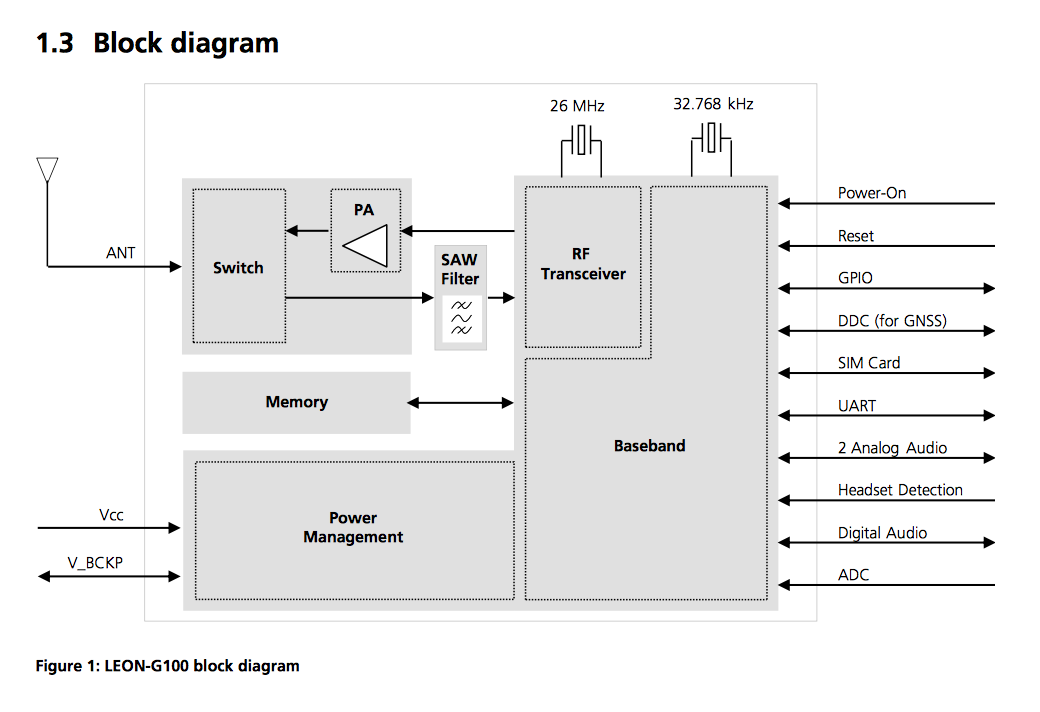
LEON-G1 series modules are cost efficient solutions offering full quad-band GSM / GPRS data and voice functionality in a compact LCC (Leadless Chip Carrier) form factor. Featuring low power consumption and GSM/GPRS class 10 data transmission with voice capability, LEON-G1 series modules combine baseband, RF transceiver, power management unit, and power amplifier in a single, easy-to-integrate solution.
LEON-G1 series modules are fully qualified and certified solutions, reducing cost and enabling short time to market. These modules are ideally suited for M2M and automotive applications such as: Automatic Meter Reading (AMR), Remote Monitoring Automation and Control (RMAC), surveillance and security, eCall, road pricing, asset tracking, fleet management, anti theft systems and Point of Sales (PoS) terminals.
LEON-G1 series modules support full access to u-blox GNSS positioning chips and modules via the GSM modem. GSM and GNSS can be controlled through a single serial port from any host processor. The LEON-G1 compact form factor and SMT pads allow fully automated assembly with standard pick & place and reflow soldering equipment for cost-efficient, high-volume production.

1.4 Productdescription
GSM/GPRS Protocol Stack Mobile Station Class GSM/GPRS Bands
GSM/GPRS Power Class Packet Switched Data Rate
Circuit Switched Data Rate Network Operation Modes
Table 2: LEON-G1 series GSM/GPRS characteristics summary
3GPP Release 99 Class B1
GSM 850 MHz
E-GSM 900 MHz
DCS 1800 MHz
PCS 1900 MHz
Class 4 (33 dBm) for 850/900 Class 1 (30 dBm) for 1800/1900 GPRS multi-slot class 10 2 Coding scheme CS1-CS4
Up to 85.6 kb/s DL3
Up to 42.8 kb/s UL3
Up to 9.6 kb/s DL/UL3 Transparent mode Non transparent mode
I to III
LEON-G1 series - Data Sheet
Encryption algorithms A5/1 for GSM and GPRS as well as the bearer service fax Group 3 Class 2.0 are supported. With correct configuration via AT commands the module can also function as GPRS multislot class 8 device.
The network will automatically configure the number of timeslots available for usage by the module.
The network automatically configures the channel encoding used by the module, depending on the conditions of the quality of the radio link between cell phone and base station. If the channel is very noisy, the network may use the most robust coding scheme (CS-1) to ensure higher reliability. If the channel provides good conditions, the network can use the least robust but fastest coding scheme (CS-4) to obtain optimum speed.
Direct Link mode is supported for TCP sockets.
Display of Called Number Indication of Call Progress Signals Country/PLMN Indication Country/PLMN Selection International Access Function Service Indicator
Emergency Calls Capabilities
Dual Tone Multi Frequency (DTMF) Subscription Identity Management Service Provider Indication Abbreviated Dialing
Fixed Number Dialing
Barring of Dialed Numbers
SIM Application Toolkit
ME-SIM lock
Call Hold/Resume (HOLD)
Call Waiting (CW)
Call Forwarding (CFU, CFB, CFNRy, CFNRc)
Call Barring (BAOC, BOIC, BOIC-exHC, BAIC, BIC_Roam) Call Deflection (CD)
Explicit Call Transfer (ECT)
Multi-Party (MTPY)
Calling Line Identification Presentation (CLIP)
Calling Line Identification Restriction (CLIR)
Connected Line Identification Presentation (COLP) Connected Line Identification Restriction (COLR) Unstructured Supplementary Services Data (USSD) Advice of Charge Charging (AoCC, AoCI)
Calling Name Presentation (CNAP)
Network Identify and Time Zone (NITZ)
1.5 ATcommandsupport
The module supports AT commands according to 3GPP standards: TS 27.007 [1], 27.005 [2], 27.010 [3], and the u-blox AT command extension.
For the complete list of the supported AT commands and their syntax see the u-blox AT Commands Manual [4].
RIL (Radio Interface Layer) drivers for Windows and Android are available for LEON-G1 series.
1.6 Supported features
Table 4 describes the main features supported by LEON-G1 series modules. For more details, see the LEON-G1 series System Integration Manual [6] and u-blox AT commands manual [4].
Network Indication All Antenna Detection All Jamming detection All
Embedded TCP and All UDP stack
FTP All HTTP All
SMTP All GNSS via Modem All
AssistNow Software All CellLocate® All
GPIO configured to indicate the network status: registered home network, registered roaming, voice or data call enabled, no service.
The feature can be enabled through the +UGPIOC AT command.
Antenna presence detection capability is provided, evaluating the resistance from the ANT pin to GND by means of an internal antenna detection circuit.
The antenna detection feature can be enabled through the +UANTR AT command.
Detects “artificial” interference that obscures the operator’s carriers providing access to the GSM service and reports the start and stop of such conditions to the application processor (AP). The AP can react appropriately, e.g. by switching off the radio transceiver to reduce power consumption and monitoring the environment at constant periods.
The feature can be enabled and configured through the +UCD AT command.
Embedded TCP/IP and UDP/IP stack for TCP and UDP sockets.
Sockets can be configured in Direct Link mode to establish a transparent end-to-end communication with an already connected TCP socket via serial interface.
File Transfer Protocol functionalities are supported via AT commands.
HTTP protocols are supported. HEAD, GET, POST, DELETE and PUT operations are available. Up to 4 client contexts can be simultaneously used.
SMTP protocol is implemented. It is possible to specify the common parameters (e.g. server data, authentication method, etc.), send an email to a SMTP server. E-mails can be sent with or without attachment. Attachments are stored in the module local file system.
Full access to u-blox positioning chips and modules is available through a dedicated DDC (I2C) interface. This means that wireless module and positioning chips / modules can be controlled through a single serial port from any host processor.
For more details see the GNSS Implementation Application Note [7].
Embedded AssistNow Online and AssistNow Offline clients to provide full developed to provide better GNSS performance and faster Time-to-First-Fix. The clients can be enabled / disabled with an AT command.
Enables the estimation of device position based on the parameters of the mobile network cells visible to the specific device based on the CellLocate® database:
-
Normal scan: parameters of the visible home network cells are only sent
-
Deep scan: parameters of all surrounding cells of all mobile operators are sent CellLocate® is implemented using a set of AT commands for CellLocate® service configuration and position request.